



BoJack Horseman is a dark animated adult tragicomedy which follows the life of a humanoid horse, BoJack Horseman, as he tries to find his way back into stardom amidst his alcohol addiction and self-loathing.
BoJack horseman fulfils the criteria for narcissistic personality disorder. He sees himself as better than everyone because of a popular sitcom, Horsin’ Around, that he starred in 20 years ago. He frequently changes reality to make himself seem better, and often gets caught up with these fantasies of unlimited success, power, brilliance, and ideal love.
Not only that, BoJack truly believes that he is special and can only be understood by and should associate with other people who are special or of high status. He regularly refers to himself as separate from those who are not famous, “you see, this is why I don’t go out among the Not-Famous”. This is also evident from his treatment of Todd – his roommate– in the first couple of seasons. He sees Todd as a normal person, therefore, someone less than him. It is as if BoJack is doing him a favour by merely allowing him to be in his presence. Even when BoJack fails, he keeps up this condescending tone that he is still above everyone else.
When his movie Secretariat becomes successful BoJack starts acting extremely entitled. This is in complete contrast to before the film’s release when he was concerned that it would destroy his entire self-image because he technically was not in it, they had to AI him in. This shows that BoJack’s self-esteem is completely dependent on what others think of him. Another example of this is when he begs Diane “I need you to tell me that I’m a good person”. Not only that, BoJack believes that everyone should forgive him simply for the reason that he is BoJack Horseman, without making any actual changes or efforts to earn the apology. He believes he should be exempt from consequences. E.g. Herb Kazzaz, Penny, Sarah Lynn.
BoJack requires excessive admiration. A lot of the time, BoJack only keeps people around to receive love and praise even when he doesn’t really care about them as a person. However, when BoJack doesn’t get the admiration he so desperately craves, he spirals and obsesses over his own image. He uses people, toying with them when he wants to feel better about himself and then pushing them away the next second.
BoJack exploits his alcoholism and addictions to hide behind his poor decisions and selfishness. He refuses to take accountability and uses it as an excuse to point to when people inevitably abandon him, “It’s not you, you tell yourself, it’s that bad thing you did”.
Lastly, BoJack exhibits a lack of empathy. He consciously chooses to hurt those around him. A clear example of this is when BoJack decides to sleep with Emily (someone Todd was interested in). Even though BoJack knows that the betrayal will harm Todd, he still chooses to remain silent about it since he doesn’t understand the seriousness of the situation enough to decide against doing it at all. He decides to maintain selfish.
Borderline Personality disorder is a pervasive pattern of instability of interpersonal relationships, self-image, and affects, and marked impulsivity. To be diagnosed as BPD, an individual needs to have a minimum of 5 symptoms out of 9 which BoJack exhibits. BoJack often fears being left out, being unloved or being abandoned. This is evident in his relationships as they are often volatile. He fears that people will leave once they “see who he really is”.
BoJack has an unstable mood. His mood changes at the flip of a switch and he has a tendency to lose control easily when he is agitated or rejected.
BoJack also has a highly unstable self-image and sense of self, often explicitly stating that he hates himself, doesn’t know how to change and constantly questions who he is.
BoJack has chronic feelings of emptiness and expresses that nothing he does matters or that he is “poison”. He tries to fill this void with fame, validation and substances. BoJack is an alcoholic and drugs are central to his story. In season one, episode 11, BoJack goes on a drug filled bender in attempts to write a better book than Diane. Another bender that BoJack goes on is in season 3, episode 11, with Sarah Lynn, (which includes a lot of reckless driving) which eventually ends tragically. BoJack also impulsively sleeps with people he shouldn’t.
A differential for BoJack could be avoidant personality disorder. BoJack often shows restraint in intimate relationships because of the fear of being shamed or ridiculed (as shown by Wanda) as he believes he is inherently unlovable. Therefore, pushing people away before they can reject him sabotaging himself. He is obsessed with how people view him and preoccupied with being criticised or rejected in social situations.
Overall, BoJack Horseman’s mental state throughout the series aligns with Persistent Depressive Disorder. It is not just present during stressful or low times, but almost a persistent baseline that he stays at. More importantly, it is pervasive, going well beyond 2 years. We see him in this state in flashbacks when he was younger, and later in the future too when his life circumstances improve, even pervading when he goes to rehab. It is important to note that he has never had a manic or hypomanic episode.
Criterion B of PDD mentions the need for 2 or more symptoms. BoJack has a poor appetite (often seen bingeing unhealthy junk food), insomnia (often seen staying up late to watch his old sitcoms), and low energy (seen lying around motionless, or drinking excessively without moving for days). Not only that, BoJack has extremely low self-esteem and catastrophises. This is embedded in his identity and he consistently views himself as a failure, and unworthy. He often feels hopelessness, and doesn’t even feel joy in success or fame. Throughout the series, the audience gets a deep look into BoJack’s negatively warped thought processes and how his thoughts spiral. Some examples include:
“I’m poison. I come from poison, I have poison inside me and I destroy everything I touch. that’s my legacy. I have nothing to show for the life that I lived and I have nobody in my life who’s better off having me.”
“Go talk to her, idiot. Drink first. No, you stupid alcoholic. Talk to your daughter. You’re ruining her. You know that, right? No matter what, your poison is already in her, there’s nothing you can do. That’s not true. Yeah, it is, you’re real stupid, and everywhere you go, you destroy people. Of course, your mother never loved you, what do you expect? That’s why Sarah Lynn died, that’s why Charlotte will never forgive you. What you gonna do to Hollyhock? What you gonna do? Shut up”
“I don’t know how you expect me to feel better when I don’t even know what feeling better feels like.”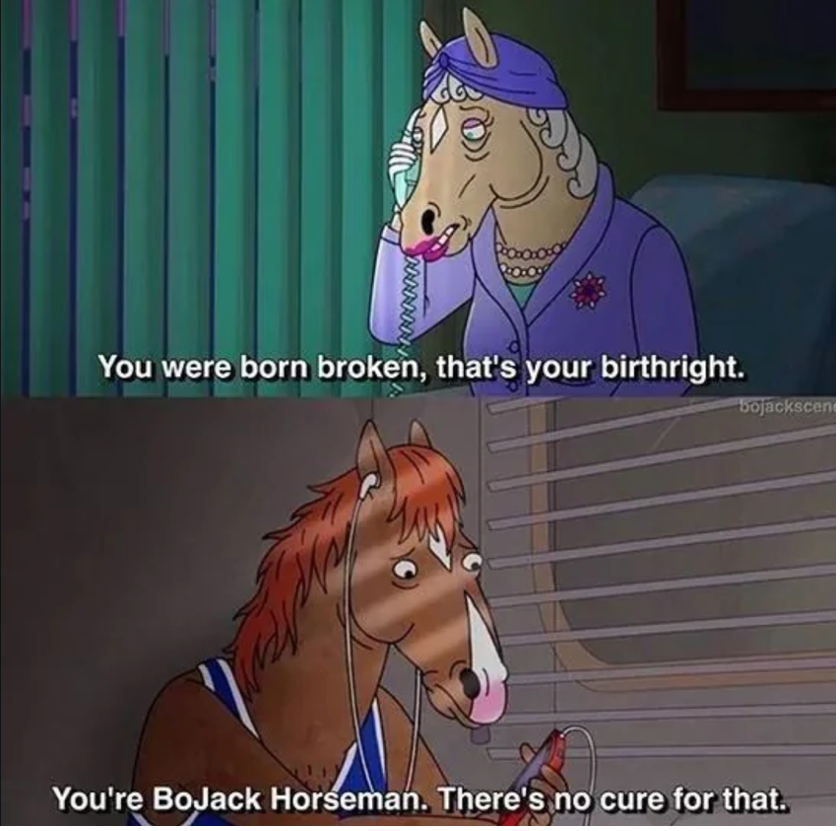
A possibly aetiology is BoJack’s upbringing. As a child, BoJack has been ignored, directly abused by his parents and shown a lack of affection. His mother, Beatrice, was outwardly cruel, calling him a mistake and blaming BoJack’s birth for ruining her appearance and life. As a result, she expected BoJack to compensate for it by being a successful person. This led to BoJack growing up to be someone who repressed his emotions and had difficulties opening up to other people. BoJack’s father, Butterscotch, was aloof, hardly ever spent time with him unless he was forced, and when they did spend time together, BoJack was consistently berated, physically abused or actively devalued. Butterscotch would often guilt trip BoJack into not telling Beatrice about his adultery. As a result, BoJack became someone who lacked the conscience whether something he did was right or wrong. This could also be the underlying cause of his inability to maintain stable romantic relationships with women as an adult, leading to his sexual impulsivity and risk taking behaviour. Butterscotch introduced him to alcohol from an early age, whereas Beatrice forced him to smoke cigarettes when he was still a minor, leading him to rely on substances as he grew up.
As BoJack got older, he became more insecure, more desperate for external validation, and his belief that he was unlovable and not good enough became stronger. And after BoJack became famous, he was able to cope with this negativity by placing himself on top of a high pedestal, assuming that the damage he faced made him special in some way. Therefore, BoJack developed this inflated ego and sense of self-importance, but never received the affection and compassion necessary to truly make him feel good about himself.
Psychodynamically, BoJack’s id is highly active. BoJack’s childhood unmet emotional needs manifest as cravings for external validation, attention, and affection, no matter how destructive the path to get them is. This drives him toward constant pleasure-seeking behaviours like binge drinking, drug use, impulsive sex, and fame. On the other hand, BoJack’s super ego dominates his thoughts, leading him to feel intense shame, guilt and self-hatred. The ego, which is supposed to balance them, is weak, leading him to spiral.
He is stuck in a vicious cycle; his id dominates causing him to act out, due to his superego he feels intense guilt and shame, and to cope with those feelings, he turns towards unhealthy coping mechanisms which sometimes backfire. Then, when BoJack doesn’t feel any better, his belief that he is unworthy, unlovable and beyond help is reinforced, deepening his depression. Even when BoJack takes step towards getting better, such as by entering rehab or attempting to make amends, his efforts are hindered by his inability to forgive himself.
BoJack Horseman is complex and would require long term therapy focused on emotional regulation and rebuilding his self-concept. Change is possible, even for BoJack Horseman.
“Sometimes I feel like I was born with a leak, and any goodness just slowly spilled out of me and now it’s all gone.”
— BoJack Horseman
