



Rumination is defined as cognitive processes characterized by thoughts or themes that persistently and repetitively arise to a degree that prevents the functioning of an individual’s mental processes (American Psychological Association [APA], 2023).
Simply, rumination is the continuous, repetitive thinking about an event in the hopes of ‘figuring out something useful’. But rather, your brain is just stuck in an exhausting trap without actually solving anything. Rumination can be about past or future events; an individual can ruminate in response to an upcoming exam and can go away once the event passes [2]. Rumination can also present as a symptom in various mental health conditions such as depression, anxiety, phobias, obsessive-compulsive disorders and even schizophrenia.
It’s important to differentiate rumination from worry, reflection and procrastination.
According to Nolan-Hoeksema et al., rumination is based on the prolonged processing of negative material whereas worry is based on processing unclear information. Rumination tends to be more past/present focused, and is mainly in reference to loss of something whereas worry is more future focused and condesned into themes of impending threat [3].
Rumination keeps you stuck in that same loop, constantly replaying that conversation, that memory for new insight but providing none. Reflection allows you to think deeply and examine your underlying emotions to gain self-awareness allowing you to move forward.
Similarly, rumination keeps you trapped in that loop never leading to a resolution. Procrastination is delaying a task because it feels unpleasant[4]. Both of them include inaction however, procrastination is due to the negative feelings associated with that task.
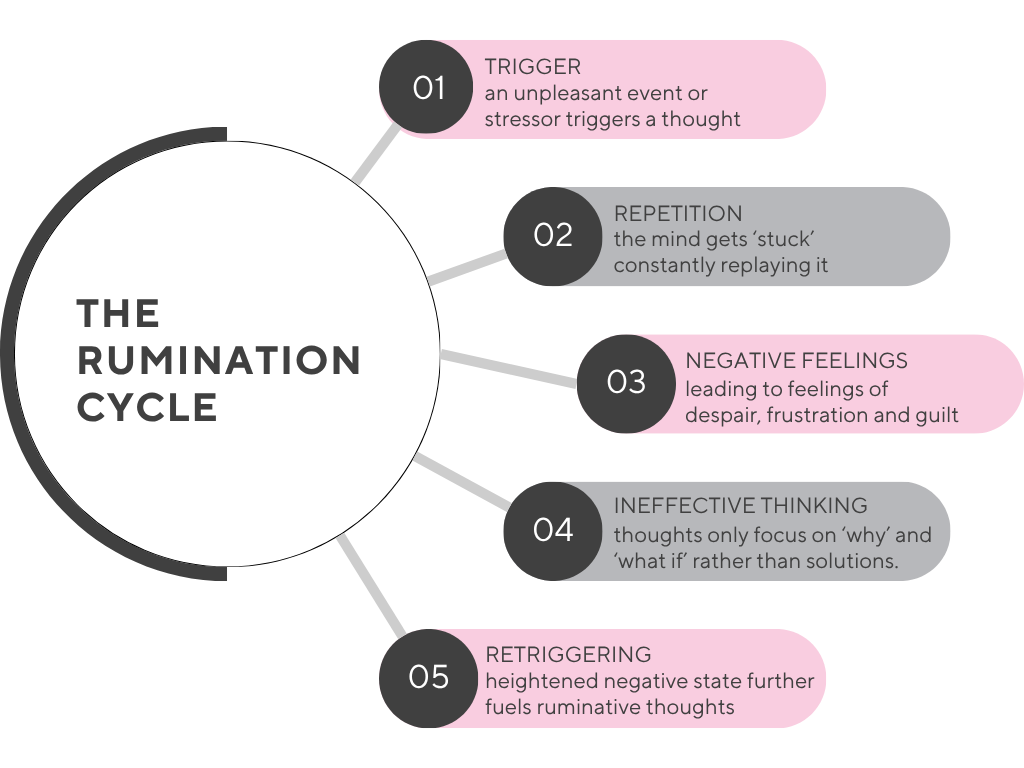
Rumination is largely a cognitive process, often letting it go unnoticed by others. The individual themselves may be unaware of the harmful consequences of ruminating, and might feel that ‘its just in their head’ further discouraging them from seeking help.
Tips for stopping/breaking that rumination cycle can include: distracting yourself. Writing it down and talking it through. This helps your brain recognize that you have acknowledged that thought and now its time to move on. It can also be beneficial to set aside time to ‘worry about it’ and then move on. Getting outside, being active and practicing mindfulness can help you ground yourself and detach from the continuous repetitive thoughts.
Therapy can also be a great way to target ruminating thoughts. Different schools of psychological intervention can target different aspects; psychodynamic therapy focusing on developing insight into the roots of your behaviour whereas cognitive behavioural therapy (CBT) targets behavioural change [5].
Withing CBT, Watkins developed a new form called Rumination-focused cognitive behavioural therapy (RFCBT) [3]. This therapy technique is founded on the idea that ruminating can either be beneficial or harmful. The treatment aims to transform the patient’s cognitive processing from unhelpful to helpful. To do this, the therapist assesses the amount of beneficial and unhelpful rumination, determines associated behaviours for each type of rumination, and then includes counter-ruminative behaviours into the treatment, such as distraction. Patients are also taught the warning signals of unhelpful rumination and action plans for interrupting.
Another approach is Acceptance and Commitment Therapy (ACT), developed in the 1980s by psychologist Steven C. Hayes [6]. Instead of trying to get rid of painful thoughts or emotions, ACT teaches people how to coexist with them without letting them dictate their behavior. The goal is not to eliminate anxiety, sadness, or intrusive thoughts, but to build psychological flexibility so you can still act according to your values, even when those thoughts are present.
ACT is built around six core processes: acceptance, cognitive defusion, contact with the present moment, self-as-context, values, and committed action [7]. Through techniques like mindfulness and cognitive defusion, individuals learn to step back from ruminative thoughts rather than becoming completely consumed by them. The focus shifts from fighting the mind to noticing thoughts without automatically getting pulled into the cycle. A major part of ACT is learning to stay present. By developing a more nonjudgmental awareness of the current moment, people can reduce the constant mental looping that often fuels rumination and anxiety. Mindfulness practices are central to this process, encouraging individuals to engage more fully with what is happening now rather than becoming trapped in repetitive thinking[8].
The first step to effectively stopping rumination is becoming aware of the cycle itself. Naming it, recognising its triggers, and understanding where it comes from can help loosen its grip over time. Rumination often feels productive because the mind convinces us that if we think hard enough, we will eventually find certainty, control, or relief. But more often than not, it keeps us emotionally stuck in the same place. Learning to step back from those thoughts, rather than constantly engaging with them, creates space and allows for flexibility to move forward.
REFERENCES:
- American Psychological Association. “APA Dictionary of Psychology.” apa.org, 2023, dictionary.apa.org/rumination.
- “How to Stop Ruminating Thoughts.” com, Medical News Today, 8 Nov. 2019, www.medicalnewstoday.com/articles/326944#summary.
- Sansone, Randy A, and Lori A Sansone. “Rumination: Relationships with Physical Health.” Innovations in Clinical Neuroscience, vol. 9, no. 2, Feb. 2012, p. 29, pmc.ncbi.nlm.nih.gov/articles/PMC3312901/.
- Diaz, Beatriz. “How to Break the Rumination Cycle and Stop Overthinking.” Insight Therapy Solutions, 14 Aug. 2025, www.insighttherapysolutions.com/blogs/break-the-rumination-cycle/. Accessed 25 May 2026.
- Salamon, Maureen. “Break the Cycle.” Harvard Health, 1 Jan. 2024, health.harvard.edu/mind-and-mood/break-the-cycle.
- Psychology Today. “Acceptance and Commitment Therapy.” Psychology Today, 21 Mar. 2022, psychologytoday.com/us/therapy-types/acceptance-and-commitment-therapy.
- “Acceptance and Commitment Therapy: Break Free from Avoidance.” Capital Psychiatry Group, 16 Jan. 2026, capitalpsychiatrygroup.com/acceptance-and-commitment-therapy-act-therapy/. Accessed 25 May 2026.
- P, Anusuya S, and Gayatridevi S. “Acceptance and Commitment Therapy and Psychological Well-Being: A Narrative Review.” Cureus, vol. 17, no. 1, 20 Jan. 2025, https://doi.org/10.7759/cureus.77705.
