

Addiction is derived from the Latin word addicere which means to deliver, give up, or enslave. According to Roman law, an addict was a person who became enslaved through a court ruling. Similarly, addiction is a disease that can make you a slave to a substance/activity [1].
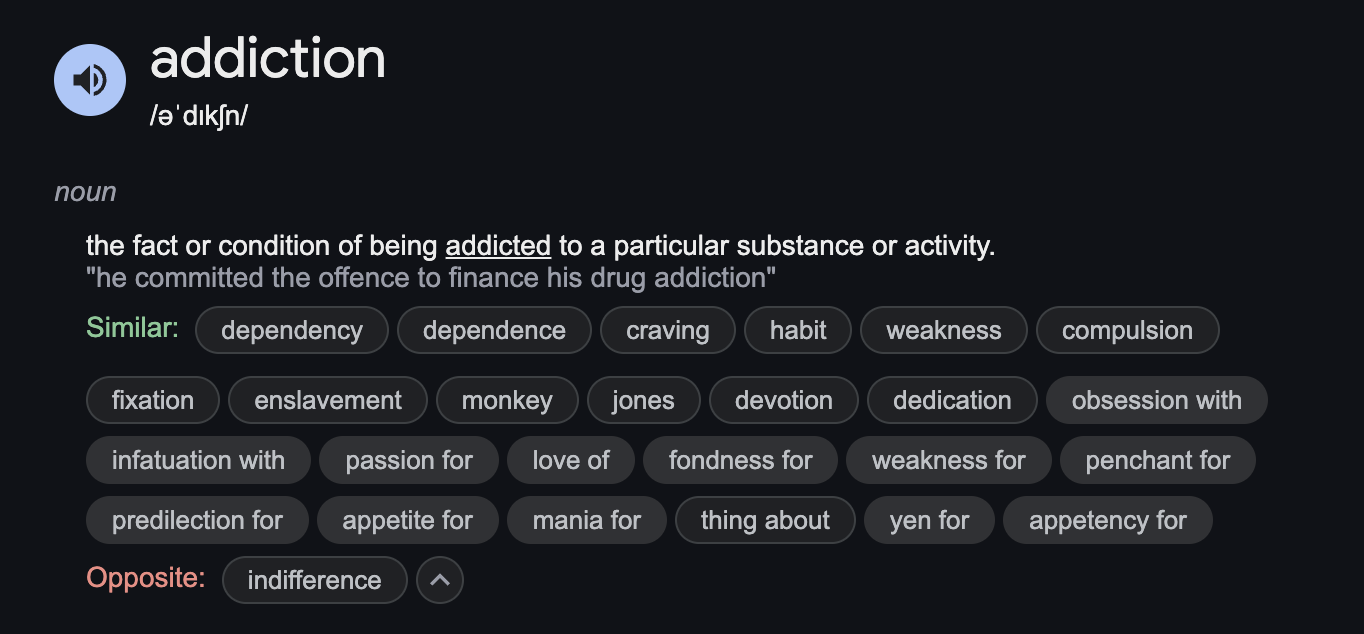
If you search for addiction on Google, the first thing it will show you is that it is; dependency, craving, a weakness, a fixation, an obsession.
Addiction is more than just a craving or fixation. It’s not simply a habit that you can break in a specific time frame, rather it is a vicious cycle that rewires the pathways in the brain affecting its very structure and function. Addiction goes further than just seeking pleasure but rather avoiding the absence of it.
The history of addiction
Throughout history, many societies have used psychoactive substances for rituals, and medicinal and recreational purposes. Archeologists have found evidence of psychoactive herbs and drugs from ancient times dating as far back as 200 million-year-old[2]. Substances like opium, alcohol, and plants were utilized and an overconsumption of them was viewed as a moral weakness rather than a disorder. Soon by the 18th century tobacco and distilled spirits became more widespread and their consumption rapidly increased.
The 18th and 19th century marked significant scientific and social shifts. Morphine was the first addictive ingredient identified in 1807 by German pharmacist F.W.A Serturner. This discovery let do significant advancements in the medical field and revolutionised pain control.
Levinstein conducted one of the initial detailed studies on morphine addiction in the late 1800’s. His work identified some key features of opiate addiction, how quickly the drug can become addictive, and the phenomenon of withdrawal that could be reversed through the use of more opiates. Another study by Gioffredi reported that serum from addicted dogs when injected in kittens, could protect kittens from large doses of morphine, suggesting the possibility of the body creating antibodies against morphine. This led to progress in opiate addiction research as different researchers applied their findings from fields like immunology, bacteriology, endocrinology, biochemistry, and pharmacology [3].
Another similar study from the early 1900s by Valenti showed that serum extracted from dogs undergoing opiate abstinence could produce similar effects when injected into other normal animals. This study strongly supported the hypothesis that a toxin can cause withdrawal symptoms leading to the Harrison Anti-Narcotics Act. The regulations of this state that those who maintained nonmedical addicts on narcotics to prevent withdrawal were to be considered illegitimate medical practice, leading to their prosecution. This was quite controversial, partly because the antibody/toxin hypothesis seemed to support a medical view of addiction.
However, in the early 1920s, E.J. Pellini published a refutation of previous hypotheses and stated that there was no organic basis for addiction and withdrawal and that these phenomena were functional or psychological. This led to a boost in research to investigate the causes of addictive behaviour as addiction was now seen as a habit that required treatment.
In 1935 there were efforts to rebirth specialized addiction treatment and Alcoholics Anonymous was founded – an anonymous supporting fellowship to help individuals tackle their alcoholism [4].
After World War two ended in 1945, there was an accelerated rate of development of a more inclusive psychiatric classification system to diagnose and treat mental health issues in soldiers – including drug abuse/addiction [5]. This period also saw an ameliorative shift in the way individuals viewed addiction: as a chronic, relapsing brain disorder. New policies were introduced that created drug categories and more flexible penalties for the usage of drugs.
The Diagnostic and Statistical Manual of Mental Disorders, First Edition (DSM-I), was published in 1952. It was heavily influenced by Adolf Meyer’s psychobiological theory and it classified alcohol intoxication as a brain syndrome. It is important to note that the DSM-I suffered from poor diagnostic reliability [6].
In the 1960s there was an increase in drugs which led to further criminalization of addiction as a moral failing rather than a medical disease. This resulted in harsher penalties for drug-related crimes and heightened stigma around addiction.
The DSM-II was published not long after and it listed alcoholism as a separate category under Personality Disorders and Certain Other Non-Psychotic Disorders. There was an improvement from its previous classification as it included subcategories and clearer diagnostic criteria. Unfortunately, it still suffered from poor diagnostic reliability.
As research moved forward the term addiction became too ambiguous and stigmatizing. As a result, the word addiction was omitted from four consecutive editions of the Diagnostic and Statistical Manual of Mental Disorders: DSM-III (1980), DSM-III-R (1987), DSM-IV (1994), DSM-IV-TR (2000). Instead, terms such as substance abuse and substance dependence were utilized as they were seen as more clinically precise.
The release of DSM-5 in 2013 introduced a new category called Substance-Related and Addictive Disorders, reintroducing the term addiction in the section heading. However, the diagnostic criteria still avoided using the term, stating clearly that “addiction has been omitted from the official DSM-5 substance use disorder diagnostic terminology because of its uncertain definition and its potentially negative connotation” [6].
In the modern period, addiction is studied from a wide variety of perspectives, including public health, psychology, sociology, and neuroscience. The biopsychosocial framework – the most prominent –acknowledges addiction as an illness that impairs both brain structure and function.
Not only that, the word addiction has become more widely applicable. It is also frequently used to express desire, determination, and excitement in popular culture and marketing. A video game or a TV show can be marketed as addictive, implying it’s something fun and fulfilling rather than being cautionary.
However, the phrase continues to be sensitive in clinical contexts, and rightfully so. The argument over addiction is far from done because of its ambiguous definition and dual character as illness and metaphor. What we refer to and how we interpret it still influences how people feel and connect to their difficulties as well as how policies and treatments are implemented.
Reference:
- Staff, N. (2017, April 2). A Slave for Addiction: The Origins of the Word. Northpoint Recovery’s Blog. https://www.northpointrecovery.com/blog/slave-addiction-origins-word/
- Saah, T. (2005). The evolutionary origins and significance of drug addiction. Harm Reduction Journal, 2(1), 8. https://doi.org/10.1186/1477-7517-2-8
- Research, I. of M. (US) C. on O. in D. A. (1996). Drug Abuse Research in Historical Perspective. In ncbi.nlm.nih.gov. National Academies Press (US). https://www.ncbi.nlm.nih.gov/books/NBK232965
- White, W., Mendell, G., & Arsenault, S. (2022, October 12). The History of Addiction. Www.shatterproof.org. https://www.shatterproof.org/blog/history-addiction
- Nathan, P. E., Conrad, M., & Skinstad, A. H. (2016). History of the Concept of Addiction. Annual Review of Clinical Psychology, 12(1), 29–51. https://doi.org/10.1146/annurev-clinpsy-021815-093546
- Rosenthal, R. J., & Faris, S. B. (2019). The etymology and early history of “addiction.” Addiction Research & Theory, 27(5), 437–449. https://doi.org/10.1080/16066359.2018.1543412
